Hank Paulson, the former Secretary of the Treasury, and Ben Bernake, the Chairman of the Federal Reserve, have come under tremendous reputational pressure in the last month for their handling of the economic crisis.
Recall WAY back in 2008, when the world was on fire. Lehman Bros. had failed, Morgan Stanley and Goldman were on the brink. AIG needed saving. I argued here that the TARP (and other alphabet soup on Fed actions) was good both for the economy and the taxpayer. It was money well spent (unlike the crap that was the Federal Stimulus bill).
Fast forward to now. Today, it was reported that the Federal Reserve made record profits from their extreme market crisis actions. They reported a $45 billion profit in 2009. That profit will be distributed to the Treasury. To quote the Washington Post, "The numbers are good news for the federal budget and a sign that the Fed has been successful...in protecting taxpayers as it intervenes in the economy." The Fed's aggressive action of buying mortgage-backed securities and other collateral from the banking system and issuing emergency loans to banks was quite effective.
Although the Fed recorded a $3.8 billion decline in the value of the loans it made in bailing out Bear Stearns and AIG, but that loss was offset by $4.7 billion in interest payments from those loans.
That's just the Fed, you say? True. But it was also reported in December that $165 billion of bank TARP funds have been returned - almost three quarters of the money distributed to banks. As per MarketWatch.com, "Bank investments of $245 billion in Treasury's 2009 fiscal year were initially projected to cost $76 billion, but are now forecast to generate a profit. 'Taxpayers have already received over $16 billion in profits from all TARP programs and that profit could be considerably higher as the Treasury sells additional warrants in the weeks ahead,' the Treasury said in a statement. "
TARP hasn't been all roses. The mistake using TARP money for other worthless items not on the original agenda like bailing out the auto industry and giving more money to AIG. Nevertheless, the White House has asked to use the returned TARP money for other hairbrained items. But clearly the banks will get some vindication, right?? ah... No.
WHY WASTE GOOD POPULIST RHETORIC EVEN IF THE FACTS DON'T SUPPORT IT?
NY Times - Obama Considers Bank Fee to Help Cut Deficit January 11, 2010, 11:39 am —
President Obama is likely to propose a fee on financial institutions to help reduce the federal deficit when he releases his budget plans in February... The bank fee would recover some of the money that taxpayers put up to bail out the financial system after its near-collapse in the fall of 2008, a rescue effort that has contributed to the largest annual budget deficits since World War II, The New York Times’s Jackie Calmes reports from Washington...With popular anger building as big banks show profits and pay sizable bonuses while unemployment remains high, the Obama administration has come under pressure at home and abroad to support a financial transactions tax on institutions and to heavily tax their executive compensation.
This is WRONG is so many ways! Here's two: 1. ummm, the BANKS aren't the one's the are going to blow up the deficit. Meanwhile, the $80 billion TARP investment in GM and Chrysler is likely ... GONE. AIG... who knows. 2. Anyone who understand economics knows that fees charged to a business institution are a hidden tax on the consumer of that institution. Fortunately (read: sarcasm), the tax won't apply to community banks. So, if you bank at Citibank, you'll help fund the deficit, but if you bank at Lakeshore Community Bank, you won't. Absurd.
Tuesday, January 12, 2010

Wednesday, December 2, 2009
House of Cards
Looking for a good book on the fall of Bear Stearns? House of Cards is decent. Although I don't think the book was particularly well written, it does a good job of chronicalling the events that surrounded the distressed sale of the fifth largest investment bank to JP Morgan. William Cohan, who also wrote the history of Lazard, took a bit of a lazy approach in this book. Rather than recreating scenes like a good author will, he fills his stories with phrases such as, "So he says to me...and then I say to him... and then he says...." At times such writing can be frustrating to read.
The book was recommended to me by a former Bear employee, so I imagine it correctly captures the demise.
Next up for me is "Too Big to Fail" by the New York Times' Andrew Ross Sorkin. Whereas House of Cards spends most of its time describing the period of 2007 and 1Q 2008, Too Big focuses its time around the disaster that was the Fall of 2008. According to one review, they make good bookends to each other.
Back to Orlando
 The Red Sox need a reliable shortstop, and an old face is in need of a job. Since trading Nomar in 2004, shortstop has been a revolving door in Fenway park; however, the man that first took the job could have/should have held it for years. In 2005, Orlando Cabrera was fresh off a World Series win, but on a new team. The Sox were leary about paying Cabrera's price, and instead paid the same dollars to sign Edgar Renteria. We all know how that went.
Yesterday, the Minnesota Twins declined to offer the mid-season acquired Cabrera, who made $4 million last season, arbitration making him an unrestricted free agent. Consequently, any team that signs him does NOT have to give the Twins compensation.
The 35-year old Cabrera is only two seasons removed from winning the gold glove at short stop. Between Oakland and the Twins, Orlando batted .284 with 77 RBIs and a .316 on-base percentage last season. Those stats aren't stellar, but the average and on-base percentage are almost exactly what Alex Gonzolez posted for the Sox last season. Current Sox target, the 34-year old Marco Scutaro, batted .282 with Toronto last season, but did have a more distinguished on-base percentage of .379.
It also should be noted that Cabrera's batting average inside Minnestota's cave, known as the Metrodome, was a terrible .231, and post the All-Star game he batted .308. In the last three years, his combined stats at Fenway were .294 avg/.368 obp/.412 slg
Let's bring back Orlando to where he belongs!Monday, November 30, 2009
Thanks Thoughts
 Had a very nice midwestern Thanksgiving. Alison's parents came to town and joined us for the Holiday. Alison and her Mom cooked a great dinner.
Although the day's football games weren't particularly exciting, it was great to kick back, and have something to watch [while taking a nap].
Although I had a to work on Friday, the crisis spurred by Dubai kept the day from being completely uninteresting. One quick word on Dubai: I'd say it's a lagging indicator rather than an leading one. Bad debt happens.
On Saturday, we cut down our Christmas tree. We have high living room ceilings, so we were able to grab a tall tree this year. I'd cuff our new tree at 9 feet. It may still be November, but we put the tree up right away.
 Sunday I got a chance to do some mountain biking (well, out here I guess its really plains biking). We have a trail here that goes about 50 miles due West. I biked about 8 miles West before heading back due to uncoming darkness. It was a fun, true rural run.
 The Luce Line is a former railroad that snakes it way through farms and lakes. Even though I didn't make it particularly far, it was a very interesting course. There were plenty of horses, cows, sheep, and even llamas. I look forward to taking the trail up past the point where I stopped; however, it's unlikely to happen until Spring.
Finally, as November gets wrapped up, I lament the Patriots loss. I said going into this game that the Saints are very good. They proved it tonight. That said, the Patriots looked as much out-of-sync as the Saints looked in-sync. A few plays go the Patriots way and this is a completely different game. Brady's first pick stands out. That in its own right is probably a 10-point swing. They need to get it together on the road. Sure, they can beat up bad teams at home, but I'd like to see one good road win.
Monday, November 23, 2009
W-E-L-K-E-R

Picture worth a 1,000 words
UPDATE: How dare the Jets cry about being disrespected! Since when is respect only a one-way street? This is the same group of "professionals" who mouthed off about "kissing rings" and seeking to "embarasss" their opponent. They name three "captains" who all played for the Patriots even though one of the them is the fourth string quarterback. How do the Patriots respond? Do they trash the media about how the Jets QB isn't the second coming of Joe Neimeth? Or how Rex Ryan's scheming plans look foolish in retrospect? Do they hold out their rings and demand they be kissed?? No, they play football and throw the ball with 30 seconds left even though they were up 14 points. WOW! And the Jets including their 500 lbs coach cry disrespect! Listen boys, one can't be respected until you learn the meaning of the word.
Wednesday, November 11, 2009
Where was This Guy on the Campain Trail?
Senator McCain's well spoken remarks on the anniversary of the fall of the Berlin Wall. Worth repeating today, Veterans Day:
In retrospect, this all seems unobjectionable. But I can assure you, my friends, it was anything but. Some objected because they thought America had no right to preach moral values when we failed to live up to them ourselves at times. Others objected because they felt the most America could do for human rights was to lead by example, but not take sides on the internal matters of other countries. Still others objected because they saw issues of morality and human rights as secondary to the real business of foreign policy – to the trade-offs, and deal-making, and interest-seeking of the world as it is, not as we would wish it to be.
We heard all of these arguments back then, and we hear them again now – for this great debate over human rights and foreign policy is as old as America itself, and it continues to this day. I know the Bush Administration spoke a lot about freedom, and democracy, and human rights. But that does not make them dirty words, and it does not make them ideas unworthy of our support today. Quite the contrary. The good thing is, America's long-running debate over whether, and how, to support human rights offers a lot of lessons to guide us at present. I'm just old enough to remember some of them, so I'd like to suggest a few of these lessons to you today.
Most important is this: The United States has a special responsibility to champion human rights – in all places, for all peoples, and at all times. Why us? The answer, I think, is simple: It's who we are. Human rights – the right to life and liberty, to the protection of property, and to rule by the consent of the governed – these values are the core of our national creed. And it is fidelity to these values – not ethnicity or religion, culture or class – that makes one an American.
And yet, human rights are not just American values; they are universal values. We embody them, but we do not own them. We think it should not be just the purpose of our government, but of all governments, to protect human rights. And when we see rulers who violate the basic rights of their citizens, it offends a sense of justice in us that we believe is shared by all people, regardless of their differences. It leads us to demand better of governments, for the simple reason that it is the right thing to do. Since America's earliest days, human rights have shaped not only who we are, but how we conduct ourselves abroad. And this should never change.
Jobs - Real and Unreal
The White House has wagered an enormous amount of its credibility on the Stimulus package and its ability to create jobs. As I mentioned in this blog previously, the pork-ulus that was the stimulus bill was a laundry list of Democrat programs that had very little to do with job creation. As that became more obvious, the tag line for the program changed from a plan to "create jobs" into "create or save jobs." Note the "or save." That part is practically impossible to track or let alone substantiate. However, as Catwoman might say, "prrrr-fect." Having "fuzzy math" (as one might call it) makes public talking points easier than hard facts. But when hard facts emerge, the talking points become more difficult.
White House economists originally floated the following graph to show how their stimulus plan would improve the jobs situation if passed. Superimposed are red dots that show exactly where we ended up even though Congress passed the plan.
White House economists originally floated the following graph to show how their stimulus plan would improve the jobs situation if passed. Superimposed are red dots that show exactly where we ended up even though Congress passed the plan.
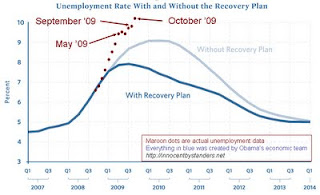
Needless to say - thanks for THAT.
Knowing clear well that it hasn't created jobs, White House moved on to hanging their hat on the "saved" part. They sent out forms to all Stimulus participants asking them how many jobs were gained or saved due to the money. Results: 1,000,000 jobs created or saved! Wahoooo!
But then the digging began. Even using their results, the spending doesn't look too good. At the time of the survey, $250 million of stimulus money was spent and $288 million of tax credits were given. So....that works out to $538,000 per job saved. Those better be pretty good jobs! But if that weren't enough - Local and national news services started to dig too, and found out that many of the supposed jobs "saved" don't actually exist.
The Sacramento Bee newspaper reported, "Up to one-fourth of the 110,000 jobs reported as saved by federal stimulus money in California probably never were in danger." A Florida paper reported that a Florida day care center that claimed stimulus money "saved or created" 129 jobs when in fact the money they got was simply used to give all existing employees raises. The Wall Street Journal reports that a Kentucky shoe store owner, Buddy Moore (no relation), saved nine jobs with $889.60 in federal stimulus money. How? Well, he supplied nine shoes to the Army Corps of Engineers. Somewhat confused, he determined that those nine engineers couldn't do their jobs without shoes, so 9 shoes = 9 jobs. Even The Boston Globe reports today, "While Massachusetts recipients of federal stimulus money collectively report 12,374 jobs saved or created, a Globe review shows that number is wildly exaggerated." They go on to cite a specific instance,
"One of the largest reported jobs figures comes from Bridgewater State College, which is listed as using $77,181 in stimulus money for 160 full-time work-study jobs for students. But Bridgewater State spokesman Bryan Baldwin said the college made a mistake and the actual number of new jobs was “almost nothing.’’ "
The list goes on.
The problem stems from how people were supposed to count "saved or created" jobs. Simply stated: If any employee's salary is paid, in whole or in part [any part!], count that as a job "saved or created" by the spending. So, if a factory gets $5000, and divides that, $50 a worker, among 100 workers, thats how many jobs were "saved or created."
I liken this "jobs" survey to auto dealership customer surveys. If you have purchased a car, or had a car serviced in the last few years, I'm sure you have been subjected to the dreaded customer service satisfaction survey. On it's own, it sounds like a good idea. OEMs want to rank their service providers in terms of quality. However, on their scale of 1-5, nothing is good except a perfect score, a five. Therefore, after you've purchased/serviced a car, you get the salesman speach, "you will get contacted to take a survey. Only "5" matters, so please tell the survey taker '5' on all items. Anything less than '5' is a failing grade." In many cases, they offer you a benefit for giving all fives - free oil change, etc. So the OEMs take the time to conduct these surveys, but the data are worthless based on how the survey is constructed. Nevertheless, the OEMs don't care! They get to promote "perfect customer satisfaction."
The "saved" jobs report is the same thing. Participants who received money, don't really know how many jobs they "saved," so they provide the most optimistic scenario. There is no incentive to be conservative, because those that created the survey want to see the most amount of jobs possible. They WANT to be told what they WANT to hear.
Tuesday, November 3, 2009
TV imitates life
I found this pretty funny. I'm old enough to remember the first V, and it's way before Obama. Does Art imitate life, or visa versa? From the Chicago Tribune Entertainment Section:
Imagine this. At a time of political turmoil, a charismatic, telegenic new leader arrives virtually out of nowhere. He offers a message of hope and reconciliation based on compromise and promises to marshal technology for a better future that will include universal health care.
The news media swoons in admiration -- one simpering anchorman even shouts at a reporter who asks a tough question: "Why don't you show some respect?!" The public is likewise smitten, except for a few nut cases who circulate batty rumors on the Internet about the leader's origins and intentions. The leader, undismayed, offers assurances that are soothing, if also just a tiny bit condescending: "Embracing change is never easy."
So, does that sound like anyone you know? Oh, wait -- did I mention the leader is secretly a totalitarian space lizard who's come here to eat us?Welcome to ABC's "V," the most fascinating and bound to be the most controversial new show of the fall television season. Nominally a rousing sci-fi space opera about alien invaders bent on the conquest (and digestion) of all humanity, it's also a barbed commentary on Obamamania that will infuriate the president's supporters and delight his detractors.
Monday, November 2, 2009
Haunted Neighborhood

Our first Halloween in the new neighborhood was a success. The layout of our community is ideal for trick-or-treating. There's only one way in, one way out, and 48 houses in between. The trek started shortly before sunset. Katie was dressed in the same costume as last year, a gypsy/pirate (under the guise that no one here had seen it before). Emily took to the role of Dorothy from The Wizard of Oz.
We were joined by the Buchmueller, Anna and Tommy, plus their dad, Ross, got into things by dressing as Shrek.
 With the exception of maybe three houses, everyone gave out candy (well, expect the house that gave cans of soda pop and coupons to his local restaraunt). There was also one house that gave us adults a tasty treat as well.
Given that some areas around here are quite rural, our neighborhood was a targeted drop-off zone. If I had to guess, a couple hundred kids patrolled the streets between 6-9:30pm.
By the end, a couple pounds of candy was carried by each child. We got last years' stash to last through New Years. We'll see if the same applies this time around.
Minnesota Adventure
The Buchmuellers, friends from back in New York, came to visit us this past weekend. In an attempt to do something Minnesotan, we decided to visit Severs Corn Maze in Shakopee (http://www.severscornmaze.com/ scornmaze.com/). Along the same lines as the Outlook Hotel in the movie The Shining, Severs has a massive maze which you walk inside. However, instead of hedges, the maze is slowed into a corn field. The idea is an excellent one. The execution was o.k. at best. Although traveling though the maze was enjoyable, and the kids liked it, the puzzle itself was not particularly diificult. Each turn you took ended up somewhere. There were no dead ends or chances to get yourself lost. Nevertheless, we took pictures inside the corn stalks, and had a good time.


 scornmaze.com/). Along the same lines as the Outlook Hotel in the movie The Shining, Severs has a massive maze which you walk inside. However, instead of hedges, the maze is slowed into a corn field. The idea is an excellent one. The execution was o.k. at best. Although traveling though the maze was enjoyable, and the kids liked it, the puzzle itself was not particularly diificult. Each turn you took ended up somewhere. There were no dead ends or chances to get yourself lost. Nevertheless, we took pictures inside the corn stalks, and had a good time.

We went for the maze, fun some other attractions at the "festival" were more interesting. Beyond the standard petting zoo, and pony rides, Severs had a 3' deep corn kernal pit. Diving right in, one got to essentially swin in corn. Although you don't sink in more than a foot or so, you can certainly dig down or dive in. Needless to say, we were finding corn in some unusual places for the next few hours.

Another fun spectacle was the pig races. No highbrow horse racing here. No Bostonian dog track. This was three not-so-little pigs running around an oval in a race for a single mini donut. It was a laugh, and the kids got to root for Hammah Montana over Arnold Snortzenneggar. A couple of cheese curds later, and we were headed home.
The whole thing had a bit of a "county fair" feel, and was surely a lcoal experience.
Subscribe to:
Posts (Atom)